Results for “GambleMath https://gamblemath.org/slot-xray”
221 matches, best first.
Position-independent code
In the last article, we found where code was hiding in our samples/hello
executable, by disassembling the whole file and then looking for syscalls.
Later on, we learned how to inspect which memory ranges are mapped for a given PID (process identifier). We saw that memory areas weren’t all equal: they can be readable, writable, and/or executable.
oocdoc, Part 3 — parsing
In the previous article, I gave brummi a go. However, we’ve seen that it still doesn’t fit our requirements: we need a tool that’s fast, easy to install and configure, produces beautiful and usable docs.
Yesterday I started building my own documentation generator, and in this series I’ll present the challenges I face and how I solved them. This might show a few ooc tricks, perhaps some software design, some good, some bad, but overall I hope it’ll be a good read!
Working with strings in Rust
There’s a question that always comes up when people pick up the
Rust programming language: why are there two
string types? Why is there String, and &str?
My Declarative Memory Management article answers the question partially, but there is a lot more to say about it, so let’s run a few experiments and see if we can conjure up a thorough defense of Rust’s approach over, say, C’s.
2025 Recap: so many projects
I’ve been working on so many projects in 2025, I thought it was important for me to make a recap, if only just to clear my head.
There are many, many, many things to go through and we don’t have a sponsor today, so I’m gonna start right away with facet!
facet
facet is a project that I started working on in March of this year — that’s right, it’s only been ten months, yet it feels like an eternity.
Async fn in trait... not
Async fn in trait… not
I was planning on showing the in-progress async_fn_in_trait feature in the
context of my website, but it turns out, I can’t!
My website uses two databases: one local SQLite database for content, and a shared Postgres database for user credentials, preferences etc. Migrations are run on startup, and each migration implements one of the following traits:
Having fun with ooc
Unfortunately, the ooc language could have better documentation. In the meantime, I’d like to blog about about some features that might not be very well-known.
Nested functions
Here’s a program that prints 1, 3, 5, 7, 9:
import structs/ArrayList

main: func {

  list := ArrayList<Int> new()

  addIfOdd := func (i: Int) {
    if (i % 2 != 0) list add(i)
  }

  for (i in 0..10) {
    addIfOdd(i)
  }

  list map(|i| i toString()) join(", ") println()

}
oocdoc, Part 2 — brummi
In the previous article, we saw how to use NaturalDocs, a language-agnostic documentation generator. Today we’ll see how to use brummi, a tool specific to ooc, written by Friedrich Weber.
Generating .json files
The first step to generate docs using brummi is to use rock,
to generate a set of .json files describing the code. The --backend
command-line option allows to select which backend you want rock to use
(the C backend is the default).
NeverJam: the game jam jam game
Our January project was ambitious: a 2D puzzle game, a-la lemmings with a twist, with big and numerous levels. And of course, all using our homegrown tools, from the compiler to the level editor to the UI system and game framework.
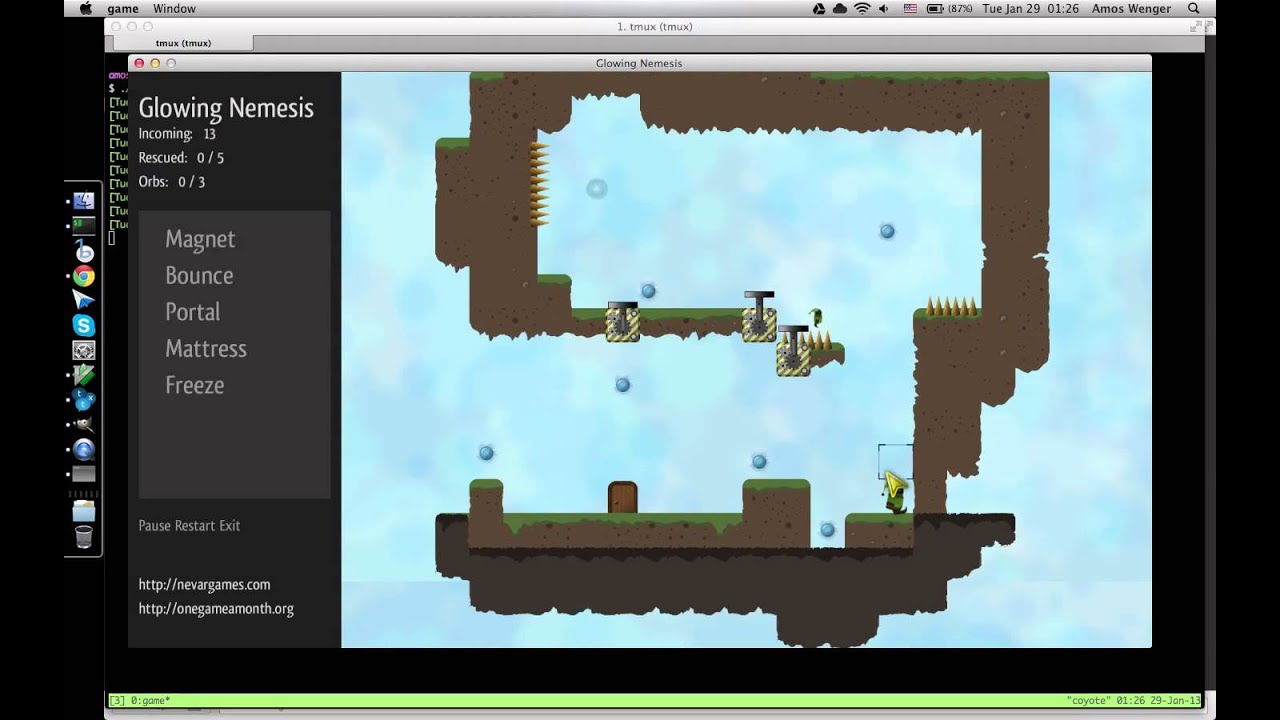
However, January ended too soon, and, sleepless nights notwithstanding, I had to resolve to publish something completely different. It was a good occasion to get to know Twine.
Surviving Rust async interfaces
I used to be afraid of async Rust. It’s easy to get into trouble!
But thanks to the work done by the whole community, async Rust is getting easier to use every week. One project I think is doing particularly great work in this area is async-std.
Let’s say we want to compute the SHA3-256 hash of a file. It’s very easy to do with synchronous I/O: